







A
ACLD
– Aged Compression Load Deflection is a material testing metric that measures how much force foam or rubber requires to be compressed to a specific deflection after it has been subjected to accelerated aging conditions (heat, humidity, fluids)
Aquamac
– The old name for Q-LON gaskets
B
Brush Piles
– Flexible weatherstripping materials consisting of dense, woven polypropylene bristles attached to a backing, designed to fills gaps in doors, windows and sliding mechanisms.
C
Capillary action
– The ability of a liquid to flow in narrow spaces without the assistance of external forces, like gravity.
CE Marking
– A CE Mark indicates that a product meets essential EU safety, health and environmental protection requirements. It is a mandatory, manufacturer-declared mark allowing products to be sold anywhere in the European Economic Area (EEA) and Turkey, acting as a passport for trade.
Compression Seal/Gasket
– A synthetic foam which creates a tight seal by being compressed between a door/window sash and the frame. Often used in casement windows.
D
Deflection Recovery
– The ability of a gasket or weatherstripping to recover its free height after compression or deflection.
Draught Proofing
– The process of sealing gaps around doors and windows to prevent cold air entering and heat escaping.
E
EcoVadis
– An international provider of business sustainability ratings, assessing environmental, social, and ethical performance across global supply chains.
EN12365 2003
– The European Standard that prescribes in detail the performance requirements of seals for doors, windows, shutters and facades.
EPD
– An Environmental Product Declaration (EPD) is a verified, transparent report detailing a product’s environmental impact across its entire lifecycle – from raw material and extraction to end-of-life product disposal.
EPDM
(Ethylene Propylene Diene Monomer) – A durable, synthetic rubber used in weatherseal strips due to its resistance to heat, cold and UV.
Extruded Seals
– A continuous length of rubber or plastic material created by forcing raw material through a shaped die to form a specific, uniform cross-sectional profile.
F
Free Height
– The height of a gasket or weatherstripping at zero load.
Flange Seal
– A precision dual-durometer elastomeric profile, designed to fit securely between two coupled surfaces.
G
Gasket
– A deformable mechanical seal designed to fill the space between two surfaces, preventing leakage of liquids or gases while under compression. They act as a barrier between components to ensure a pressure-tight seal. Also known as weatherseals or seals.
GHS
– The Globally Harmonised System of Classification and Labelling of Chemicals is an international standard used to classify hazardous chemicals, developed by the United Nations and is implemented by most major countries and trading blocs.
H
I
ISO
– the International Organisation for Standardisation, an independent, non-governmental, international body that develops technical, industrial, and commercial standards.
J
K
KOMO
– A Dutch certification foundation, representing high quality in the construction and building products industries. Ensures products, including adhesives and seals, meet strict standards for safety, durability and health, verified by independent experts.
L
Linear Compression Force
– The force needed to deflect a specimen to its maximum working range at a temperature of 23◦C ± 2◦C
M
Maximum Working Temperature
– The condition below which the gasket or weatherstripping is considered to be capable of performing.
MSDS
– A Material Safety Data Sheet (MSDS) is a technical document providing safety, handling and hazard information for chemical products. Under GHS and OSHA regulations they are required for storing, using and transporting hazardous materials.
Minimum Width
– The sum of the gaps between the infilling and the frame or bead each side of a gasket. The minimum width of weatherstripping is the distance between a point relating to the mounting surface and a point of the contact surface.
Microporous
– A finish that allows wood to breathe and moisture to escape while preventing rain ingress, crucial for timber windows.
N
O
OHSA
– The US Occupational Health and Safety Act (OHSA) sets legal duties for employers, supervisors and workers to establish a strong internal responsibility system, ensuring safe working conditions and regulating workplace hazard procedures.
P
PE
– Polyethylene, used in the film of Q-LON products
PP
– Polypropylene, used in the insert of Q-LON products
PU
– Polyurethane, used in the foam core Q-LON products
Q
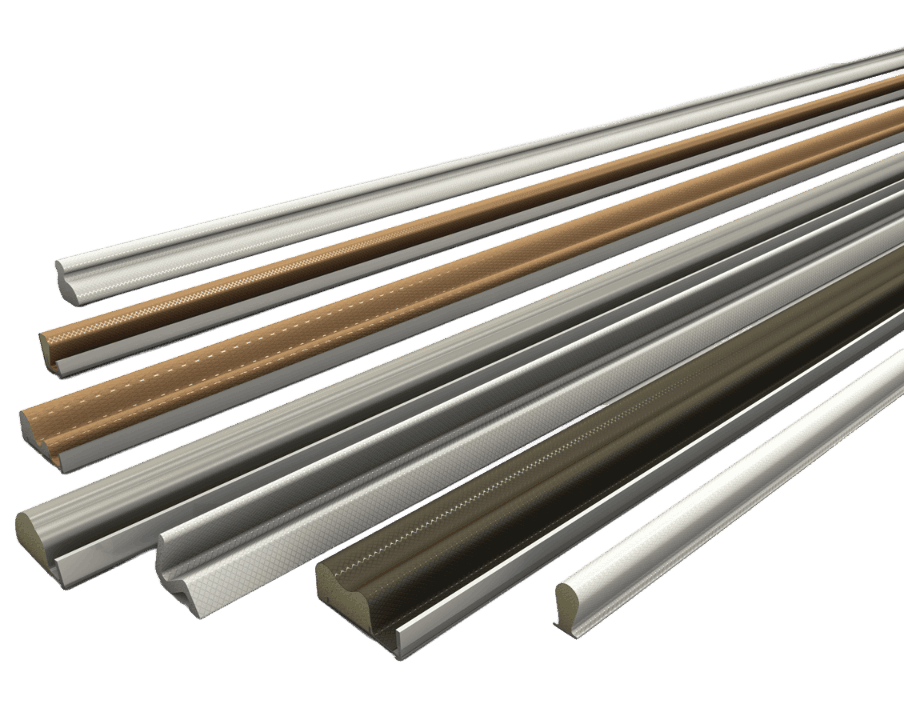
Q-LON
– A high-performance composite weatherseal. manufactured by Schlegel Ltd.
R
RAL
– A European colour management system for plastics, to ensure colour accuracy.
REACH
– An EU and UK regulation ensuring chemicals in products are safe for human health and environment. It applies to manufacturers, importers and users of substances, requiring risks to be managed and phase out hazardous substances. (Registration, Evaluation, Authorisation and Restriction of Chemicals)
RoHS
– The Restriction of Hazardous Substances is an EU directive – often adopted globally – that restricts the use of specific hazardous materials in electrical and electronic equipment (EEE) to protect human health and the environment, particularly during disposal and recycling.
S
T
TCSA
– The Toxic Substances Control Act in the USA regulates chemical substances to ensure they do not pose unreasonable risks to health or the environment. Manufacturers and importers are required to report data on chemicals.
Test Pieces
– Lengths of material cut at random from various places within the sample to provide test specimens.
Thermal Conductivity
– The intrinsic property of a material to transfer or conduct heat through its mass. Higher values indicate faster heat transfer and lower values indicating better insulation (e.g. foam)
TPE
– Thermoplastic Elastomer is a class of materials that combine processing versatility and flexible, rubber-like performance.
Threshold Seal
– A seal at the bottom of a door, often a brush or rubber strip, designed to stop water ingress from the threshold.
U
U-value
– A unit of measure for the heat loss of doors and windows. The lower the U-value, the more energy efficient the product.
UKCA
– The UKCA (UK Conformity Assessed) marking is a product certification mandatory for goods placed on the market in Great Britain (England, Scotland, and Wales). It signifies that a product meets essential safety, health, and environmental requirements set by UK legislation, effectively replacing the European Union’s CE mark for the GB market following Brexit.
V
W
Weatherpile/Brush Seal
– A flexible fin or brush strips, common in sash windows, designed to fill gaps while allowing smooth movement
Weatherstrip/Carrier
– A plastic channel to hold the weatherpile or seal in place
Wicking
– The ability of a material to pull moisture away from the skin and through the fabric to its outer surface for rapid evaporation, utilising capillary action
Wind Load
– The amount of pressure a door/window can withstand before the seal fails. Crucial for high exposure locations, like coastal areas.
Working Range
– The distance a gasket or weatherstripping can be compressed or deflected when used in a particular product
X
Y
Z
Our Accreditations